Latest Posts

Beautiful Imperfections

Welcome of Day 5 of #30PostsHathSept. [PLEASE READ all my other challenge posts HERE.] I hope you enjoy this installment!

30PostsHathSept300x200sept2015-5

With my experience as a synesthetic person, I have always looked ahead to the fall season with keen anticipation.

Soon, just be patient, I tell myself, one more month. Then the brilliant hues will unfold. The saturated living canvases will alight. The brisk breezes will sway branches, blushing in degrees of undress. These abstractions of color speak each with their own mood and voice.

Then it hits me. I realize my excitement is not just in the bursts of color, but in the acknowledgement that the process is precious and fleeting.

I’m alluding to the concept of wabi sabi, long an important and sustaining part of the foundation of Japanese culture and design.

To more deeply understand this idea, I recommend a book by Andrew Juniper entitled Wabi Sabi: The Japanese Art of Impermanence.

WabiSabiTuttle

In it, Juniper writes,


“The term wabi sabi suggests such qualities such as impermanence, humility, asymmetry, and imperfection. These underlying principles are diametrically opposed to those of their Western counterparts, whose values are rooted in a Hellenic world view that values permanence, grandeur, symmetry, and perfection.”

I don’t think it’s an exaggeration that many of us prefer our interactions with the world in which we live to be more antiseptic and two-dimensional than actual reality. We like our grass to be green. Our skies to be blue. When a bowl chips or is worn, we frequently replace it with something new. Decay disturbs us. Some people choose to undergo cosmetic surgery to relive youthful looks or enhance perfection. Other individuals seek to separate themselves from the process of the death experience due to discomfort.

But wabi sabi is the accepting of imperfections and impermanence precisely because the imperfections and impermanence are the key elements of beauty. Character. History. Wabi sabi is the life journey that emanates from an old desk or china cup, as much as a grizzled old tree trunk, or the caring face of a beloved parent or grandparent.

Everything we encounter fades. Whether or not we can understand it on our time scale. Majestic mountain peaks. Colossal redwood trees. Ancient architectural wonders. They come from nothing into existence, and will – in their timeline – go back to nothing someday. So shall all of human history.

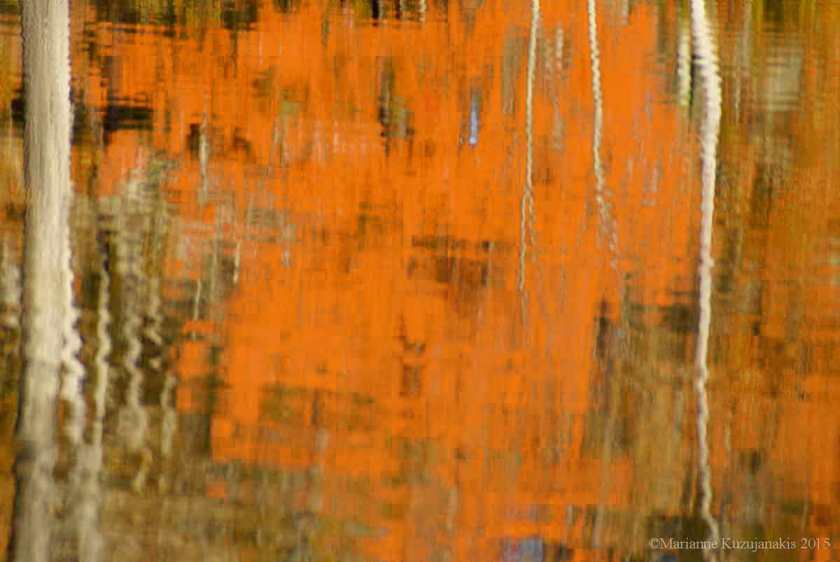
The beauty of the crimson leaf at the top of this post, while obvious, cannot minimize the concurrent beauty of the curling decay of age, the blackening scars of battle.

There are stories of transient existence and asymmetry. Beautiful stories. Stories to remind all of us that we are part of the process of wabi sabi.

Wabi sabi is not produced by purposeful destructive forces nor can it be deliberately made by design. Wabi sabi involves the natural process of living things with dignity and peace and time and contentment.

Each day when you awake, look around. See the beauty of your surroundings. Take a walk and note the irregularities that add substance and impact. Interact with your family and friends and those you do not even know. Appreciate their beauty.

Know that each time you overlook a moment, that moment changes, never to return. Time’s continuum never stops. We are all ephemeral. Wasting the limited time we have in petty arguments, misunderstandings, or excessive expectations takes away so much of life’s value.

Wabi sabi instructs all of us to connect fully with the world around us. To connect fully with those we love. We can then and only then appreciate and cherish the achingly beautiful imperfections and impermanence of life.

Every moment. Every breath.

[You can enjoy all the daily posts from the #30PostsHathSept bloggers HERE]

Listen Closely

Welcome to Day #4 of #30PostsHathSept. [PLEASE READ all my other challenge posts HERE.] I hope you enjoy this!

30PostsHathSept300x200sept2015-4

Listen closely. Sometimes that which is most important comes in whispers. All around you are the hum of whispers, beating inside every heart. If our eyes could see well beyond the spectrum of light and into the hearts and minds of those around us, we would literally topple at the profound depth of human experience.

For example, right now there are people, some you know and some you don’t, walking around day after day with what can only be described as heavy boulders. Large slabs of stone more appropriate for quarries than held across one’s shoulders. You may not yet be able to admit it, but you are also carrying one.

These boulders can be massive, multiple in number, and staggering in their weight and dimensions. Sometimes the boulders are smaller, perhaps not as unmanageable, but no less important or oppressive.

It is my belief that each and every one of us carries some of these boulders. It’s as if we have accepted this role.

But what am I really talking about? I’m talking about stress and anxiety and fears.

It’s no surprise that anxiety and stress levels are rising. It touches the lives of 40 million U.S. adults and upwards of 12-20% of U.S. children and teens. Anxiety is the most common mental health condition in the country and its costs peak at $42 billion per year.

In one study, 80% of school-aged kids report moderate to extreme stress.

Individuals of all ages experience stress and anxiety. Infants wail when they are hungry. Toddlers may shriek during thunderstorms. Preschoolers often cry when separated from a parent. School-aged children feel anxiety in making friends. Teens struggle with anxiety due to exams, homework, and the onslaught of puberty’s changes. Adults worry about finances and health. The elderly feel the approach of life’s end and the accumulating losses of those who are dear.

But what if it were possible to make stress and anxiety work FOR us, not AGAINST us? What if we could stop carrying around the boulders?

The other day in my post on procrastination, I shared a TED.com video by Dr. Kelly McGonigal entitled “How To Make Stress your Friend”. If you haven’t yet watched it, please consider doing so.

The idea is that anxiety and stress can be manageable. Inside each of us exist the means of regulating stress if we allow ourselves to trust our own bodies. In moments of stress, neurotransmitters are released producing the fight or flight symptoms, but additionally there is the release of the love hormone oxytocin.

Oxytocin brings people together. Oxytocin can act as our personal social support system. Oxytocin protects our cardiovascular system. Oxytocin can calm us. Oxytocin is much more than a love hormone. It’s a LIFE hormone. It is our own personal affirmation system.

Yesterday I was reminded of this topic as I spent quality time with family watching a favorite episode of Doctor Who, in anticipation of the new Season 9 that begins September 19.

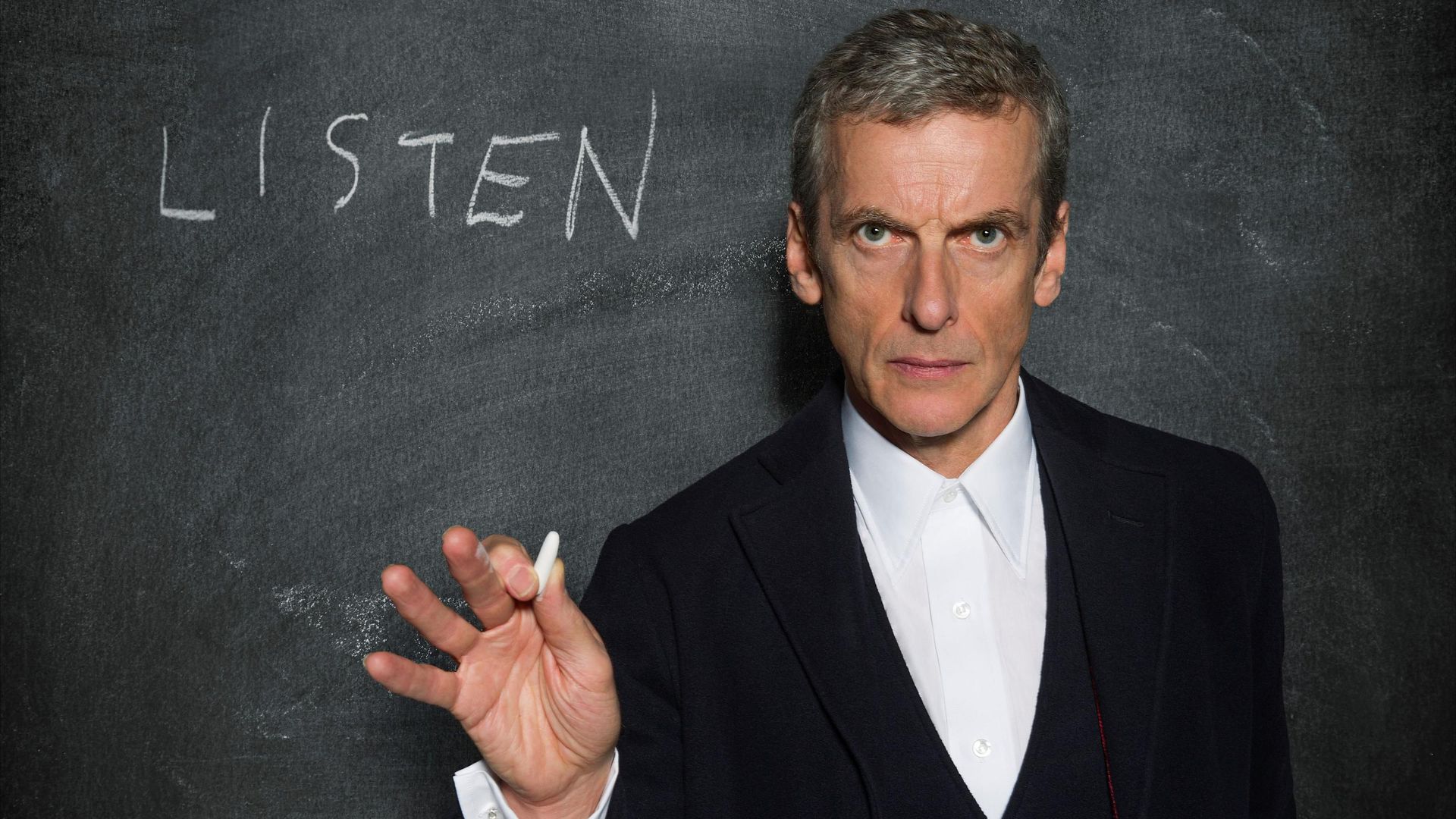
In the episode, entitled Listen, Peter Capaldi plays the 12th incarnation of the doctor in Doctor Who with Jenna Coleman (Clara) as his companion. I don’t want to reveal too much detail, for those who have yet to see it, but suffice it to say the episode can provide you with a renewed and healthy look at stress, anxiety, and fears.

ListenDrWho

Listen closely the next time you feel stress, anxiety, or fear. Be the one in control. Put down the boulders. Trust your body. Courage can grow like a phoenix from the fires of anxiety. In the words of A.A.Milne, “You’re braver than you believe, and stronger than you seem, and smarter than you think.”

We really are all alike in so many ways. We are a community. We are all part of the human race.

So please…whatever you do…LISTEN CLOSELY.

Listen, Dr. Who (2014, season 8)

Clara: “Listen. Listen. This is just a dream.
But very clever people can hear dreams.
So please, just listen.
I know you’re afraid. But being afraid is all right.
Because didn’t anybody ever tell you?
Fear is a super power.
Fear can make you faster,
And cleverer,
And stronger.
And one day, you’re going to come back to this barn,
And on that day, you’re going to be very afraid indeed.
But that’s okay.
Because if you’re very wise
And very strong,
Fear doesn’t have to make you cruel or cowardly.
Fear can make you kind.
It doesn’t matter if there’s nothing under the bed,
Or in the dark,
So long as you know it’s okay to be afraid of it.
So listen.
If you listen to nothing else, listen to this.
You’re always going to be afraid,
Even if you learn to hide it.
Fear is like…a companion.
A constant companion, always there.
But that’s okay, because fear can bring us together.
Fear can bring you home.
I’m going to leave you something, just so you’ll always remember –
Fear makes companions of us all.”

[You can enjoy all the daily posts from the #30PostsHathSept bloggers HERE]

First They Ignore You

Welcome everyone. Today is Day # 3 of #30PostsHathSept. [PLEASE READ all my other challenge posts HERE.]

30PostsHathSept300x200sept2015-3

This summer, Marcus Wohlsen wrote a negative piece for the journal WIRED entitled “Homeschooling Only Deepens Silicon Valley’s Rift With the Rest of Us”.

Though I’m not in the Silicon Valley, I’m a long-time homeschooler. Each time I hear a negative homeschool article (and there have been numerous), it reminds me of the quote often both misquoted and misattributed to Mahatma Gandhi, but quite applicable here:

“First they ignore you, then they laugh at you, then they attack you, and then you win.”

In the early decades of homeschooling, families choosing this path were seen as very few and rare. Later, many in the traditional arena felt these families, growing in number, to be asocial or weird, and unable to handle regular traditional educational institutions of learning.

Of course, this is a generalization, and not the experience of all homeschoolers. But many homeschool families have stories to share of how they were at times ridiculed, and their children were bullied and made to feel different.

But now the homeschool movement has reached a hard-to-ignore level. Over 3.4% of all U.S. children homeschool, and in numbers now exceeding 1.7 million. That’s a rise of 61.8% in one decade.

We also know that many homeschool students are statistically surpassing traditional schoolers in parameters including but not limited to college admissions, community service, and employment. These findings now place an increasing number of homeschoolers as truly viable competitors. That shift in perspective may, in part, be at play in the negatively of some recent articles.

The author of the WIRED article states,

“WIRED’s Jason Tanz published a feature story on techie homeschoolers alienated by traditional schools and in some cases by the idea of schooling itself. Not liking school isn’t exactly a radical notion—ask any kid. But at a time when the surge in tech-industry wealth is driving an ever-deeper wedge between haves and have-nots, the homeschooling trend plays into the suspicion that techies would rather live in a bubble than the world we all share. It’s not that any parents should be faulted for making what they see as the best choices for their kids. The issue is a Silicon Valley culture that can too often prize breaking away at the expense of chipping in.”

He goes on to say,

“Good intentions can breed solutionist fantasies where ‘disruption’ is the only answer. But disruption has a way of leaving the disrupted behind.”

Now, let’s step back a bit. Two phrases jump out. Chipping in and leaving behind. Let’s take them one by one.

CHIPPING IN: So many retired professionals from all walks of life have a depth of skill that would be (and should be) highly prized in the K-12 public school system. However, there is so much hoop jumping in the process of becoming a K-12 teacher. Some are reasonable, such as CORI. But many retired professionals (engineers, physicists, biologists, tradespeople, etc…) often find it far easier to teach at the community college level than go through the certification process involved in K-12. Private schools, on the other hand, are frequently more welcoming of non-certified professionals. Perhaps public schools might do well to learn from their experience. Homeschools utilize community professionals in their own education. Such professionals have so much to offer.

LEAVING BEHIND: I can only touch upon the irony of this term. Many homeschoolers would still be in public school if it weren’t for the simple fact that THEY (not the schools) were the ones left behind. The gifted and creative students. The divergent and twice-exceptional students. The outliers and misunderstood. These are all the students who fill the communities of Silicon Valley and elsewhere. They are the students who are forging ahead with a new vision of education. They are the hackers. The self-directed learners. The innovators. The risk-takers.

Lest we forget why so many of these students have fled the public school system, read Dr. Peter Gray’s article in Psychology Today on what many creative people throughout history have said about compulsory education in general.

Elon Musk, with his own account of childhood school bullying, took his own children’s education so seriously that he began his own private school. Its focus is very similar to how many homeschool. Watch the video here:

Now that homeschoolers and the homeschooling movement has reached a point where traditional schools feel threatened, perhaps the final point of the aforementioned quote is coming nearer to we win.

But that the homeschooling movement wins isn’t really the point. The winning comes from supporting ALL STUDENTS in the best way possible.

I’ve always been a huge fan of public schools and the difficult work educators must perform. But for my child, homeschool was always a better option. I have also felt privileged to have had the opportunity to homeschool, a privilege that others might indeed deem unfair. But it hasn’t been an easy road by any account.

I additionally know there are countless remarkable K-12 educators who are deeply dedicated to the students. Sadly, many feel their hands are tied by the rules of NCLB and Common Core. Some educators have even left the K-12 system to homeschool their own children.

To move forward, K-12 schools must be open to the fresh ideas proposed by homeschoolers and others that honor the individual and support both individual strengths and differences.

After all…EDUCATION is about LEARNING.

Learning can be messy. Sometimes learning can even be scary. It includes making mistakes, not being penalized, and getting up and brushing off the dust. Learning means moving forward towards mastery. Learning means community. It means finding passion. It means finding support for those passions. Learning takes the risk it requires to let go of old ways and embrace new ones.

Today is our new Sputnik time. We are all on the same side.

The real and deserving “winners” will be all of the students.

[You can enjoy all the daily posts from the #30PostsHathSept bloggers HERE]

Procrastination…Wait, There’s a Squirrel!

Lately, I’ve been thinking a lot about procrastination. It’s also been a really great way to push off my many other responsibilities. It’s also Day #2 of #30PostsHathSept, so here goes… [See the other posts HERE.]

30PostsHathSept300x200sept2015-2

Traditionally, in the gifted field, procrastination has been associated with perfectionism. The sense that avoidance of a task or a last minute rush to the finish may be defense mechanisms against fear of failure or what is termed the imposter syndrome. Many researchers have discussed these issues, including psychiatrist Dr. Jerald Grobman. Or join Dr. Deirdre Lovecky in her article on “The Procrastinator’s Guide to the Galaxy“. The gifted field is also filled with the work of Dr. Dabrowski and his theory of overexcitabilities, leading one to extrapolate that highly sensitive individuals may be more prone to anxiety associated with certain tasks that may lead to procrastination of those tasks.

But does this fully paint a portrait of procrastination?

Does fear of failure and the accompanying anxiety it produces (or simply anxiety itself) always lead to procrastination? Does it serve to protect the ego to say, “Well, I didn’t do as well as I could, but I didn’t really spend that much time on it.”? Does it stroke the gifted ego to say “See, I knew I’d do well on the exam without studying.”?

Many gifted students (and other students as well) suffer with a lack of motivation for required tasks. Beyond issues of fear of failure, many gifted students are said to procrastinate tasks that are too simple, as an avoidance of boredom. Thus, procrastination can be multi-factorial. Teasing out the cause for procrastination in any specific individual can be difficult. Anxiety may play a role, but sometimes only indirectly.

Anxiety may not be the primary emotion involved. Sometimes an array of “uncomfortable” emotional states is the culprit. States such as frustration and disinterest. Patience as well. These days, it is much more difficult to both witness patience and be patient. Life feels rushed. People persist in believing they can master time, knowing full well that without a TARDIS, that is extremely unlikely.

There are proven techniques that can help us become more patient (and tolerate those around us who are not): mindfulness and meditation. We’ve heard so much about these two topics, and for a good reason – they can positively change our brains. We can become more patient while all the while the world seems intent on overwhelming us.

Importantly, researchers have likewise tied procrastination to impulse control, a condition under the jurisdiction of the pre-frontal cortex. Lack of impulse control is precisely what is associated with diagnoses such as ADHD, and is oftentimes seen in the asynchrony of giftedness. Dr. Piers Steel, in this week’s Wall Street Journal, writes:

“People may assume anxiety is what prevents them from getting started, yet data from many studies show that for people low in impulsiveness, anxiety is the cue to get going. Highly impulsive people, on the other hand, shut down when they feel anxiety. Impulsive people are believed to have a harder time dealing with strong emotion and want to do something else to get rid of the bad feeling.” – Dr. Piers Steel.

So, the psychology soup gets thicker. What comes first? Procrastination? Anxiety? ADHD? Do they mimic each other? Are they intrinsically connected? Do they occur along a spectrum?

We’ve all heard time and again that ADHD is on the rise. It’s diagnosed in 11% of children as a whole, including 20% of all teen boys. Anxiety is also on the rise. Guess what? Procrastination is on the rise as well. There are even Procrastination Anonymous communities across the world. Each of these conditions can be often addressed through the same path – mindfulness and meditation.

What does this all mean? Plus..What role does society and progress and technology play into the rise in procrastination?

In the past decade alone – in the time frame when the rise of ADHD, anxiety, and procrastination has been greatest – we’ve seen massive cultural changes. Facebook. Twitter. Netflix. Instagram. Youtube. Demand TV. At any moment we can video chat with friends and family around the world. Need to buy a book or specialty jam or stylish jacket? A few clicks on the computer from the comfort of your armchair can get you want you want, when you want it. With technology comes so many positives, without a doubt. But what’s the cost?

Is the human brain capable of adapting so quickly to these changes in a healthy way?

All of these advances can also act as distractions. We’ve likely all heard the stories of those who sleep text and text walk, sometimes resulting in tragic consequences. Much research is looking at the effects of Internet addiction, in line with past video game addiction studies.

Ultimately, I still cannot grasp the true underlying etiology of procrastination. I ponder the chicken vs. the egg dilemma. And through all my reading, I can’t predict with clarity those who are more susceptible to procrastination and those who can resist, except for one single issue: impulsiveness.

Impulsiveness. It’s on the rise, but why? Of course there is ADHD, but what of general impulsiveness? Is it intrinsic in specific individuals or laying dormant in all of us? Is it part of each of us that is only more apparent as we, as a species, try to assimilate the growing information evolution? Perhaps it’s a safety valve, so to speak, to change our focus away from the constant onslaught. Those more sensitive may have differing levels of tolerance.

It only seems appropriate that the researchers discussed in the aforementioned Wall Street Journal article would have discovered a successful treatment for procrastination that is done online. Since technology already has our attention, technology may serve to relieve its own consequences.

It should not come as a surprise that technology, which serves to both assimilate external input as well as internal changes at the level of neurotransmitters, is our species greatest challenger.

Who will be the victor?

Why not take 15 minutes minutes out of your day to watch this TED.com video with psychologist Dr. Kelly McGonigal, the author of The Willpower Instinct, as she talks about stress reduction and the love hormone, oxytocin.

And until tomorrow…Be mindful, turn off technology for awhile, and take time to meditate.

[You can enjoy all the daily posts from the #30PostsHathSept bloggers HERE]

Learning At The Event Horizon

Suppose you heard the phrase #30PostsHathSept Blog Challenge. Would you be intrigued…or would you run away?

sept2015-1

Maybe I need to have my head examined, but I’m jumping with absolutely no idea of whether or not I’ll surface unscathed (or surface at all).

Conceived by my friend, the author Lisa Rivero, #30PostsHathSept challenges bloggers to write one post each day throughout September. Short, long, filled with videos or images, it matters not. What solely matters is the ultimate sense of accomplishment felt through a daily ritual and meditation of self-expression. So join us for a new season, the new academic year, this new daily blog challenge. [See the other posts HERE.]

TO BEGINDay #1 (#30PostsHathSept)

Even before September’s arrival, fall has been creeping into my thoughts ever more closely. Fall is a time for fresh starts and new promises…and a perfect match for this blog’s challenge. Fall is a shaking off of the sands of summer and a re-focus on 7th-inning stretch of the year.

As a homeschool educator, I keenly feel the tug of fall. I take seriously my responsibility to facilitate my teen’s educational needs. Each new school year offers brand-new ideas, interests, and opportunities.

But as I reflect upon my homeschool journey, and education in general, I’m reminded on how knowledge is exponentially expanding everyday. Students in each generation are confronted with ever more vast quantities of information at every turn. Courses. Textbooks. Websites. Video. Audio. Email. Text. Social media. The influx of information is 24/7. There also is no likelihood of seeing a slowing of information’s spread.

The standards of what a student must know to be educated make the assumption that student are carbon copies of one another. “Vessels to be filled”. But each student brings years of experiences to each educational encounter, and assumptions of standards often clash with reality.

So what is truly essential to learning?

Big question, indeed. Individuality dictates that every person has his or her own interests and strengths that assist in the process of learning. Through years of experience, I have discovered that what is learned is never as important as the process of learning itself.

By supporting my teen’s interests, I try to instill a sense of independence of choice and direction. I’m a firm believer that children are born with intense curiosity for the world around them, and a deep need to understand this world. We owe all children the unbridled freedom to express their endless questions and seek answers that bring them ever more closer to understood truths.

Truths…ah, truths. Truth is a subject onto itself. Sometimes truth is knowledge with an expiration date. Understanding that knowledge can (and does) change is a crucial life skill.

And while I’m a strong proponent of subject mastery in education, an education solely composed of regurgitating known information is often done so at the cost of learning how to learn. It is important to learn to be cognizant that as information changes, we must change as well.

One should never stop asking questions. Never stop dancing at the edge of knowledge and thriving in uncertainty. Never stop seeing the interconnectedness of everything. Innovation co-exists within this event horizon. So does progress. Art. Science. Our future survival.

What is essential to learning comes not from content, but from attitude. Curiosity, passion, and knowing how to learn are skills far more important than those tested for on state exams. Understand the child who stands before you as a unique being and discover his or her interests. Never be in a position where you are asked what your child loves to do and punt the answer to the child.

Know intimately what makes your child tick. Water those seedlings and allow them to grow into beautiful gardens.

Consider the question of essential learning for yourself. Begin by taking a look at Ted.com’s incomparable Sir Ken Robinson, as he discusses personalized learning.


Also, read the New York Times discussion on ignorance to understand how much more there is to learn, and consider reading one of my current favorite books entitled Ignorance: How It Drives Science, by neuroscientist Dr. Stuart J. Firestein.

Trust yourself. Trust your child. Until tomorrow…I leave you with few quotes.

——————–

“I know one thing, that I know nothing.” – Socrates

“The important thing is not to stop questioning.” – Albert Einstein

“Man’s mind stretched to a new idea never goes back to its original dimensions.” – Oliver Wendell Holmes Jr.

“The illiterate of the 21st century will not be those who cannot read and write, but those who cannot learn, unlearn, and relearn.” – Alvin Toffler

“We live on an island surrounded by a sea of ignorance. As our island of knowledge grows, so does the shores of our ignorance.” – John A. Wheeler

“What we want is to see the child in pursuit of knowledge, and not knowledge in pursuit of the child.” – George Bernard Shaw

[You can enjoy all the daily posts from the #30PostsHathSept bloggers HERE]

Number Six Burns Like An Orange Flame

Say the number six and it sits at my temples, a serrated moist tangerine sheen moving like fire. I prefer the number seven, pale turquoise and floating like a cottony cloud before my eyes. But my favorite has always been the number four, earthy, silent, smelling of mushrooms, and cube-shaped.

I can admit this now, without self-consciousness.

As a child I thought everyone perceived the world in this way. Until I realized they didn’t. To avoid ridicule, I quickly learned to keep silent. The same silence recognized by some others of you reading this now. To me, numbers appear in color. Letters appear in color. Emotions are evoked by these splashes of hue. Have you ever burst out in tears while in a museum looking at Mark Rothko’s color field paintings? The experience is visceral and embarrassing. It offers some comfort to know that others have had this same experience or a similar one when listening to a piece of music.

Only a short decade ago I found out this condition has a name: SYNESTHESIA.

The world is perceived differently by a person with synesthesia. Furthermore, each synesthete perceives colors and senses in unique ways different from other synesthetes. Synesthesia is not typically taught in medical school. To those unfamiliar with synesthesia, it may be falsely considered a disorder. No citations can be found in any of the major pediatric medical journals. In adult medical journals it has sometimes been associated with drug use or a personality trait along a broad continuum that, in its far extreme, includes schizophrenia. Classic migraine sufferers with visual auras may have a higher incidence of synesthesia. Some report a higher incidence in those with autism. One famous autistic synesthete is Daniel Tammet, author of Born on a Blue Day.

Synesthesia in its true sense is not a mental health condition, artificially-induced condition, nor anything more than an inheritable trait, much like hair color and height.

Estimates place all combined forms of synesthesia at 3-4% of the population. Synesthesia may in fact define a new type of gifted, requiring a new approach to education, as reported HERE. It is reported more frequently among artists, musicians, poets and writers. Only recently is synesthesia becoming more recognized in the mainstream. In his book, researcher Dr. Cretien van Campen calls synesthesia “The Hidden Sense”, and for some it remains so in part for fear of judgement.

Synesthesia essentially means “one-sense” and was even mentioned by the ancient Greeks. A mixing of signals between what we in western cultures learn are the five basic senses of taste, touch, sight, hearing, smell. I say “western cultures”, as other cultures do not always split the senses so discretely. Dr. van Campen makes this point in his book, and others have also noted cultural differences.

Each synesthete experiences the world in a different way.

It’s important to mention that people with synesthesia are not all alike. Some synesthetes taste sounds. Some hear colors. Some sense music on their skin.  Some can even “taste rainbows”. Some, like me, limit their synesthesia to mostly numbers and letters. Dr. Sean Day, president of the American Synesthesia Association, states there may be as many as 63 varieties of synesthesia. Dr. Day was recently interviewed by BlogTalk Radio/ The CoffeeKlatch about this subject.

But what is synesthesia and why do some people experience it? Dr. Richard E. Cytowic, a researcher in synesthesia, produced this Ted-Ed video introduction:

Neurologist Dr. V.S. Ramachandran also discusses synesthesia mid-way through his TEDTalk. It seems that some of our brain’s sensory-related systems occur in very close conjunction with each other. Too many interconnections (or too few) can entirely change the way we perceive our environment.

The close anatomic basis and the brain’s neuroplasticity may make synesthesia more common than we believe it to be.

Especially in a child’s developing brain there is a constant building and pruning of connections. In my opinion, it isn’t entirely out of the question to consider that crossing and re-crossing of senses may occur at this and other fragile points of life.

Some children are known to experience a hypersensitivity to external inputs, be it auditory, visual, tactile, taste, or odors. A number of these children may be diagnosed with sensory-processing disorder. I sometimes wonder if a subset of these children are simply experiencing varying levels of synesthesia that become overwhelming.

Synesthetes are inspired by colors. The same can be said of most children. Some parents may be told their children are natural visual and musical artists. Watch them paint. A blue horse? What’s abnormal about that? Children love to make music (and dance to it) in a wild spontaneous way. The music makes them feel emotion and sense color. Have a child draw a picture of music. More than likely they will splash the paper with a variety of colors dependent upon what emotions and colors speak to them through the music.

With time, many of these same children either lose their synesthetic perceptions or begin to conform to societal and cultural expectations. Only a small actual percentage of adults retain and express synesthesia traits.

My own son since a very young age has been very particular about color. When he was quite young, this has often been to the dismay of art teachers. He could easily spend most of an entire class just mixing the “right” blue or green or red. To ask a child with synesthesia to paint something blue is asking a lot. So much goes into choice and the “wrong” color speaks loudly like nails on a chalkboard.

Some researchers who have looked into whether synesthesia can be learned, believe it can to some degree. We do know synesthesia can be acquired, in particular through brain injury as was the case with Jason Padgett who became a mathematical savant synesthete after a significant brain injury.

Researchers are now using genetic testing and brain imaging to better understand synesthesia.

Perhaps the ability for synesthesia exists asleep in each one of us,  just out of reach and consciousness. But the lack of complete understanding is a jolting reminder that there is still so much more to learn about the mind and how much caution we must meanwhile take in interpreting human behaviors and abilities.

Whether synesthesia is a strength is certain. Award-winning musician Pharrell Williams has been very vocal about his synesthesia. A few other well-known synesthetes include Duke Ellington, David Hockney, Richard Feynman, Itzhak Perlman, Vladimir Nabokov, Norton Juster, Vincent van Gogh, and many many more.

It is a definite comfort to share a unique ability with such an illustrious group. But the surprise and subsequent fear people as a whole experience of being different often keeps them prisoners in their own minds. This is true of synesthetes as well as anyone with an ability that exists outside the narrow range that society labels with the term “neurotypical”.

The message that cannot be said too often is this: The whole of society needs to more readily embrace atypical minds. The strength and the future of the human race is in our differences, not our similarities.

Some organizations for more information:

American Synesthesia Association
The Canadian Synesthesia Association
UK Synesthesia Association
The Synesthesia List
The Synesthesia Project

Some children’s & young adult books with characters having synesthesia:

PICTURE BOOKS:
The Noisy Paintbox by Barb Rosenstock & Mary GrandPré
The Girl Who Heard Colors by Marie Harris & Vanessa Brantley Newton
MIDDLE-GRADE BOOKS:
A Mango-Shaped Space by Wendy Mass
One Plus One Equals Blue by MJ Auch
The Name of This Book Is Secret by Pseudonymous Bosch
YA BOOK:
Ultraviolet by R.J. Anderson

“Let me, O let me bathe my soul in colours; let me swallow the sunset and drink the rainbow.” Kahlil Gibran

This article also appears in The Huffington Post HERE.

This article also appears on The Coffee Klatch blog HERE

Unstoppable

Biologist, Dr. E.O.Wilson, spent many countless childhood hours watching ants. His unremitting interest eventually led to his ground-breaking research into sociobiology and biodiversity, becoming renown as the world’s leading expert on myrmecology.

Dr. Terrance Tao, mathematician, spent endless childhood hours playing with puzzles and math problems. His consuming passion led him to becoming one of the youngest Fields Medal winners. He’s received many major mathematical accolades in areas of combinatorics, harmonic analysis, matrix theory, and other areas.

Dr. Seuss (aka Theodor Geisel), children’s book author and illustrator, spent numerous childhood days at the zoo with his father (the superintendent of parks), sketching animals that would one day inspire the fantastical creatures that inhabit his timeless, world-famous and award-winning books.

Through these examples, I’m reminded of the wisdom spoken by Paul Graham in a January 2015 article stating,

“The stranger your tastes seem to other people, the stronger evidence they probably are of what you should do.“

Further examples of gifted children with unique passions who followed those passions into careers could fill volumes. In the book Far From The Tree, author Andrew Solomon describes prodigies, each experiencing an intrinsic motivation to fully understand and expand upon a specific unrelenting passion. This motivation was given a name by Dr. Ellen Winner in her book Gifted Children: Myths & Realities. She termed it rage to master. Dr. Winner explains that these gifted children “…exhibit an intense and obsessive interest, an ability to focus sharply…”. Rage is an apt term.

Try to stand between a child and his/her passion. What results is anger, frustration, sadness.

A related term, coined by Dr. Brock Eide & Dr. Fernette Eide, alludes to the gifted brain’s hyper-sensitivity & increased glucose utilization as seen on fMRIs.  Brains on fire.

This increased glucose utilization is truly interesting, as I have heard from so many parents including myself who speak about a physical need for food that comes when their child is intensely learning. Skip a meal and these children may experience symptoms analogous to that of a diabetic with hypoglycemia. Rage to master can be thought of as the intellectual component of the over-excitabilities of Dabrowski.

Those who have witnessed rage to master in their own gifted children or in the children of friends or relatives undoubtedly have seen both the advantages and disadvantages to this way of learning. It is without question a hunger. A devouring of information and experiences. An unstoppable force of nature.

But this hunger can be at odds with traditional ways of learning.

Children with rage to master seem out-of-place and time with other children and adults.

More often than not, the passion is unique and not one shared with age-peers. In the book High IQ Kids, in the chapter by Judy Fort Brenneman, she discusses how her profoundly gifted child was a poor fit for the school. Neither the special education classroom nor the mainstream classroom suited his needs. His behavior became unacceptable. What the school said was “If only he could slow down so we could teach him.” The mother replied with “Why can’t they speed up?” Exactly.To.The.Point.

Children like this perform with intensity at home, consuming information and always creating to better understand their world and their thoughts. Yet at school, they are asked to decelerate learning. To slow down. To brake.

BREAKING NEWS: They can’t decelerate. Asking them to stop learning and creating is nothing short of cruel and inhumane. Think about Kurt Vonnegut’s profound story “Harrison Bergeron” and the true meaning of equality. Think of Stephanie Tolan’s excellent essay “Is it a Cheetah?

Families with these children are placed in a nearly impossible position by then requesting acceleration for their child. It isn’t acceleration, per se, these children need. It’s appropriate education at their level of need. FAPE (Free Appropriate Public Education). These children aren’t asking for something above and beyond an appropriate education. If other children are being given a challenging education, so should these children. The difficulty and ambiguity of the definition of FAPE and gifted education is a discussion for another time.

Acceleration, after all, may simply be a fuzzy politically correct term. Consider the ramifications of calling it by its proper name – appropriate education – and then try to withhold it for a child.

How could one in all fairness justify deceleration in the presence of suitable ability?

But many school districts do not accelerate. Some allow for pull-out classes 1-2 times per week. Some schools do not even recognize ability if accompanied with a learning disability. Other schools, when confronted with acceleration, instill a worry in parents about socialization (as if socialization in a class where the child cannot relate to the slowed pace and is repeatedly made to feel wrong or broken is somehow healthy). This, despite large amounts of evidence to the contrary, as reported in A Nation Deceived.

So what happens when a gifted child with rage to master is denied the opportunity to fulfill that passion? Families are all too familiar with the outcomes. Acting out in class, depression, somatic symptoms (headaches, stomachaches), school refusal, underachievement, and being  labeled by professionals for attentional issues, conduct disorder, learning disabilities. Of course, some of these children may have mental health and/or learning disabilities in conjunction with their rage to master. Determining with accuracy the presence of a disorder requires first addressing the educational environment.

One powerful story of a misunderstood gifted child comes from this blog’s reflections upon Ken Robinson’s excellent book The Element.

It is our responsibility as adults and parents and educators to strive to understand the needs of all our children and to acknowledge a child’s inner feelings. To help understand such a child’s inner feelings, I have never come across anything more potent than this poem by Pearl S. Buck.

“The truly creative mind in any field is no more than this: A human creature born abnormally, inhumanly sensitive. To him…
A touch is a blow,
A sound is a noise,
A misfortune is a tragedy,
A joy is an ecstasy,
A friend is a lover,
A lover is a god,
And failure is death.
Add to this cruelly delicate organism the overpowering necessity to create, create, create — so that without the creating of music or poetry or books or buildings or something of meaning, his very breath is cut off from him. He must create, must pour out creation. By some strange, unknown, inward urgency he is not really alive unless he is creating.”

Do I have my own stories about my child? Absolutely. Suffice it to say right now that my son has been permitted to explore his passions through unstructured homeschooling for the past decade. Not every day is completely rosy, as no one’s life is always thus, but freedom to learn is a right to be cherished and upheld no less than any other human right.

“Don’t ask what the world needs. Ask what makes you come alive, and go do it. Because what the world needs is people who have come alive.”  -Howard  Thurman, author, theologian, civil rights leader

This article also appears in The Huffington Post HERE.

Book Review: “Take Joy” by Jane Yolen

To say Jane Yolen is prolific is an understatement. With over 300 books spanning children’s literature to science fiction to fantasy and poetry, plus more literature awards than I can count, it is no surprise that she deeply loves the craft of writing. Perhaps known to many as the author of The Devil’s Arithmetic, as well as Owl Moon (winner of the 1988 Caldecott Medal with illustrator John Schoenherr), Yolen has a reputation for being a generous mentor for aspiring writers.

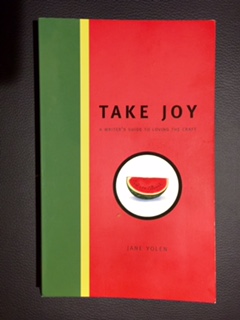
Yolen’s love for writing can be felt in page after page of a book I only recently came to own after hearing about it from a writer friend. Take Joy: A Writer’s Guide to Loving The Craft delivered to me precisely what it promised. The book’s gleaming red cover has at its center a single slice of watermelon alluding to the advice within. Sweet. Refreshing. Whimsical. Joyful.

This isn’t a traditional step-by-step guide to writing. Of course it covers all the essentials: voice, theme, point-of-view, endings and beginnings, etc…as well as her famous BIC writing advice. Yet all topics are delivered in a way that is pure Yolen. Where else can writers learn about the so-called Boogerman voice? Or get the sense of a writer’s creative thinking style? Her many metaphors, anecdotes, and quirky turns of a phrase entertain and inspire. Her imaginings of famous books written in sparse outline are alone worth the read, as in Moby-Dick = Fishmeal.  After all, Jane Yolen is not an outliner, stating that “Outlines know everything about the book, and nothing about the story.” So true. Story is forever boundless.

Take Joy: A Writer’s Guide to Loving the Craft is a wonderful read. I place this book alongside classics like Bird by Bird by Anne Lamott. Of course there certainly are many other books delivering a far more detailed analysis of the art and craft of writing. Take Joy is slim at less than 200 pages. Still, one would be hard-pressed to find many delivering considerable usefulness in such a light-hearted and compact way.

One point is clear. Jane Yolen repeatedly reminds us through her written musings that it is so important to understand that writing is a way of thinking and existing, and not just an act of doing. A writer doesn’t stop writing simply by putting down the pen or laptop. Life itself, experienced through all the senses, is the 24/7 research providing writers with the nourishment necessary for both writing and the soul.

So in keeping with Jane Yolen’s sage advice, ”Breathe in the world”.

Picture This

Children’s literature has always had the power to surprise, entertain, and touch hearts. I am a huge fan. I have a special love for picture books, as they are meant to enthrall the youngest of children. Thinking about picture books elicits images of parents snuggled closely with their children, sharing warm and happy times together. Every child deserves to be surrounded by high quality books to share together with the adults they love.

March is Read For Research Month organized by children’s author Carrie Charley Brown. For each day of March, picture book writers will read a variety of picture books, using them as mentor texts, and then apply what they’ve learned into their own manuscripts. Accomplished author-educators will host daily writing-related discussions and make additional mentor book suggestions.

“But how hard can writing a picture book possibly be?” some ask.  Ouch. The discomfort is awfully familiar. When people first hear I am a pediatrician, more than a few have actually said “Oh, I thought you might have been a real doctor.” Ouch again. Some picture book writers can relate.

People do not always perceive children’s authors as real writers.

But writing exceptional picture books is difficult. The limited word counts, the lyricism, the imagery, the precision of thought, and the duet between writer and illustrator, all must come together seamlessly.

So where do mentor texts come in? Learning from mentor texts can further a writer’s knowledge of story and help develop a deeper appreciation for genre. In those brief 32-40 pages, picture books contain a wealth of information that translates to all writing genres. A few such components include the following:

  • VOICE  lays the framework for story. It provides tone, word choice, and mood. Is the story humorous (i.e. Mo Willems and his pigeon books)? Sentimental (i.e. Brown & Hurd’s Goodnight Moon)? Inspiring (i.e. Seuss’ Oh, The Places You’ll Go!)? Or satirical (i.e. Scieszka & Lane’s The Stinky Cheese Man)? Is the story nonfiction? About a beloved toy? A retelling of a folktale? A concept book? Poetry? Voice is important to all. Word repetition and rhythm are a part of voice, as is dialogue.
  • TENSE provides a depth of connectedness to the story. The immediacy of present tense vs. a separation from past. Some stories work best in the present tense, whereas others may feel stilted. Future tense is another option, especially in books speaking directly to the reader.
  • NARRATOR is the story’s storyteller. This voice behind the story can be an external observer or in direct contact to the feelings and thoughts of one or more of the characters. The narrator may even be one of the characters. The narrator can be a child or adult, and voice is intrinsic to the narrator. Imagine, as an exercise, changing the narrator of your favorite picture books. Curious George from George’s perspective, perhaps?
  • THEME is the story beneath the story. The big picture message. Examples like love, hope, friendship, family. Theme is best implied. Spoken outright, a theme can seem like a lesson. Subtlety is by far more acceptable to both children and adults. A powerful theme like the acceptance of human difference is articulated in a fun and fantastical way in David Small’s Imogene’s Antlers.
  • CHARACTERS – ahhh characters – they ARE the story. Where would stories be without memorable characters? Just say a character’s name and evoke story. Babar. Amelia Bedelia. Corduroy. The Grinch. Ferdinand. Lyle. Eloise. Olivia. Fancy Nancy.  The main character (protagonist) moves the story along and is intimately linked to theme, conflict, and resolution. But watch out for the antagonist who acts as a barrier to the protagonist’s success.
  • SETTING grounds the characters. It can be real or imagined, internal or external, expansive or minimal. Setting is often central to the storyline and sometimes is felt to be a character of its own. The illustrations are crucial to setting. Crockett Johnson’s Harold & The Purple Crayon will be forever influential for its minimally illustrated setting that evolves through the hand of Harold.
  • PLOT involves the progression of time and space. It folds together the character with the conflict. In books for older children, flashbacks can be inserted to break-up a linear storyline. Picture books need to be cautious as nonlinear timelines can be more difficult for younger children. David Macaulay’s success with Black and White is an example that works. Foreshadowing, which elicits predictability, is very effective and satisfying.
  • CONFLICT is the obstacle to whatever goal or desire the protagonist is trying to reach. It is essential in nearly all stories. Some action (physical, emotional) involving the main character must occur as a result. Tension, pacing, and motivation all play roles. What ultimately happens can propel a simple story idea (bedtime, new sibling, snowstorm, lost toy, etc…) from mundane to sublime. Just think about Trixie and her father during their traumatic visit to the laundromat in Mo Willem’s Knuffle Bunny.
  • CONFLICT RESOLUTION has long been stereotypically described in children’s fairy tales as “…and they lived happily ever after.”  But the best of children’s stories don’t usually end in such a simplistic way. The mark of an effective children’s book is an ending that is both a surprise and inevitable. The ending wraps up everything that’s come before it, logically and emotionally. In essence, how a story resolves is what makes a story satisfying. In Where the Wild Things Are, can you feel the love between mother and son in the soup bowl left in Max’s room?
  • ADDITIONAL TOOLS accessible to writers include (but never limited to) the use of symbolism, archetypes, simile, metaphor, allegory, and many other literary elements.

But as important as these story components and tools are to story, superior to all of them is a concept no story should ever ever be without:

VERSIMILITUDE

Simply defined, verisimilitude is the illusion of being real. Radiating truth. There is nothing more important to story than verisimilitude. Many authors agree.  A book with verisimilitude permits us to suspend disbelief and be fully committed to story. The power of story is in its magic. It allows us to believe in Hobbits, and in imaginary worlds like Roxaboxen. It offers us precious childhood friends like the precocious Olivia, as well as Christopher Robin and all the animals in the Hundred Acre Wood. How many children grew up to be environmentalists in part because of The Great Kapok Tree? How many people can reminisce upon a childhood toy with the same feelings evoked by The Velveteen Rabbit?

We praise authors not for their beautiful books but rather because they are the conjurers of worlds.

Here is one list and another of classic picture books to begin your exploration. The Caldecott Medal honors some of the very best picture books each year.

Whose childhood literary magic is engraved upon your soul?

Fiction is the truth inside the lie, and the truth of this fiction is simple enough: the magic exists.” – Stephen King

The Misunderstood Face of Giftedness

Reprinted with permission from The Huffington Post [April 10, 2013]

In K-12 classrooms everywhere are children at risk for being misunderstood, medically mislabeled, and educationally misplaced. Not limited to one gender, race, ethnicity or socioeconomic group, they could be the children of your neighbors, your friends, your siblings, and even yourself.

These at-risk children are gifted children.

Contrary to common stereotypes, giftedness is not synonymous with high academic achievement. Some are the class clowns, the lonely awkward child in the back row, the troublemaker. Special needs classrooms are where a number of gifted children end up — their giftedness left unsupported.

The gifted student archetype, while expected to be a mature classroom leader, does not fit all gifted students.

Wasting much of their day in unsuitable classrooms, gifted kids may behave in unacceptable ways. Despite giftedness being akin to a special need, funding for it is scarce and the needs of gifted minority and poor are repeatedly and shamefully overlooked. Visual-spatial learners whose learning methods conflict with typical classrooms are also misunderstood. While classrooms need to be academically challenging, for many that also requires sensitivity to cultural, racial and linguistic diversity. Learning strengths, too. Such solutions are not always generally available.

Dr. William H. Smith, former dean of the Karl Menninger School of Psychiatry and Mental Health Sciences, stated, “Giftedness can be confused with some psychiatric disorders, obscure other disorders, and it often needs to be included in treatment planning.”

But many gifted children are never identified. Gifted identification is mandated in only 32 states, and funded in fewer. Most teachers receive only minimal instruction on the identification and management of gifted children. The term gifted tends to evoke elitism, and serious attention is rarely paid to gifted children who are other than high achieving.

A prevalent belief persists that one cannot both be gifted yet struggling in school. Many parents also discount giftedness when their children’s abilities are uneven or counteracted by other difficulties. Yet some gifted children who have unrecognized learning disorders may initially excel in school, until they hit a limit where their compensatory skills unravel.

The 2010 American Academy of Pediatrics Task Force on Mental Health reported that nearly 37 percent of children and adolescents either met the DSM criteria for a mental health diagnosis or showed some impairment in functioning. ADHD is seen in nearly 1 in 10 children. Autism spectrum disorders are seen in 1 in 50 children.

This is a global crisis. Pediatric primary care physicians diagnose psychiatric conditions and prescribe psychotropic medicine, but rarely feel adequately prepared by their training to do so.

Highly gifted children are a particular diagnostic challenge.

They seem to be wired differently and have developmental trajectories that differ from the norm. Many gifted kids experience the world with heightened and vivid intensities and sensitivities that may be a big plus (allowing them to become creative artists, scientists, inventors, and humanitarians) but also can be a big minus (subjecting them to sometimes overwhelming emotions and worrisome and unacceptable behaviors).

When pediatric diagnoses are carelessly applied, gifted children are frequently mislabeled with ADHD, autistic, depressive, or bipolar disorders.[1]

Dr. Jack Wiggins, former president of the American Psychological Association, stated, “This is a widespread and serious problem — the wasting of lives from the misdiagnosis of gifted children and adults and the inappropriate treatment that often follows.”

Yet sometimes being gifted effectively hides learning and mental health conditions. Giftedness may over-compensate for weaknesses, masking the weakness and sometimes the giftedness. Despite the seriousness of misdiagnosis, physicians are exposed to an alarmingly few articles in the pediatric medical literature about the complexities of giftedness, while many parents also hesitate in discussing giftedness with their doctors, some with the belief that giftedness plays no role in medical health.

Dr. James T. Webb, clinical psychologist, author, and founder of SENG (Supporting the Emotional Needs of the Gifted), stated, “Unfortunately, extremely few psychologists, psychiatrists, pediatricians, or other health care professionals receive any training about characteristics of gifted children and adults, particularly behaviors of bright, creative persons that can sometimes resemble or conceal disorders.”

So, while some gifted kids are erroneously labeled and medicated for mental health disorders they do not have, others are unrecognized for learning or mental disorders they do have.

Normal giftedness can be easily confused with a diagnosable mental disorder. Gifted kids may talk a lot, have high levels of energy, and be impulsive or inattentive or distractible in some settings — similar to symptoms of ADHD. It’s not unusual for gifted kids to struggle socially, have meltdowns over minor issues, or have unusual all-consuming interests — all pointing to an inappropriate diagnosis of autism.

What results is that the gifted frequently feel alone and alien in a world that doesn’t fully understand them.

Dr. Daniel B. Peters and Dr. Edward R. Amend, both clinical psychologists, in a chapter of Handbook for Counselors Serving Students with Gifts and Talents (2011), wrote, “Although there is no doubt that medication has its place in the management of behavioral and psychological disorders … the practice is not appropriate when medication is incorrectly used to suppress the misunderstood behaviors of gifted children.”

Giftedness too is not always seen as a socially positive and valued trait. Many gifted kids are bullied, others underachieve to hide their abilities, and some experience anxiety and depression with increased risk for self-harm.[2] As many as 20 percent may drop out of school.[3] The social and emotional needs of many gifted children are ignored. Many seek homeschool and early college as more suitable alternatives, though some bypass higher education altogether, having become disillusioned with their earlier experiences, or unable to cope if untreated for unrecognized learning or mental health issues.

There is an urgent need for physician training in giftedness and dual diagnoses. They see kids for very brief visits and many are too influenced by drug marketing (as are parents and teachers). Over-diagnosis and over-treatment are commonplace.

The typical 15-minute exam is not sufficient to accurately distinguish disorders. A gifted child presenting with distractibility or inattentiveness may or may not have ADHD. A seemingly bright child who just gets by in school may be severely struggling with an unrecognized learning disorder hidden by gifted over-compensation. Gifted children may also hide depression and suicidal thoughts.

It is crucial to properly distinguish pathology while accurately addressing concerns. Sometimes the best remedy is simply proper educational placement. Thus, when medical diagnoses are made too quickly, the required conversation abruptly ceases and opportunities to make a positive difference are lost.

The book Misdiagnosis and Dual Diagnoses of Gifted Children and Adults (2005) offers helpful advice in distinguishing if a gifted child also has other issues needing further evaluation:

• Does the developmental history indicate early milestones or precocious development?

• Are the behavior patterns typical ones for gifted children and adults?

• Are the problem behaviors found only in certain situations or contexts, rather than across most situations?

• Are the problematic behaviors reduced when the person is with other gifted persons or in intellectually supportive settings?

• Can the problematic behaviors be most easily explained as stemming from a gifted/creative person being in an inappropriate situation?

• Are the behaviors ones that really cause an impairment in personal or social functioning, or are they quirks or idiosyncrasies that cause little impairment or discomfort?

Finally, the concept of normal must not be defined by a narrow and arbitrary set of criteria. Not everyone processes information and sensory inputs in the same way, nor does everyone develop along the same expected timeline to the same endpoint. Variability does not automatically indicate a disorder.

Dr. Allen Frances, psychiatrist, author, and chair of the DSM-IV, states: “One of the disasters of the diagnostic inflation is that expectable and desirable individual difference is so often mislabeled as mental disorder. Caution is particularly necessary in diagnosing kids. They are so developmentally labile and have such a short track record that diagnostic mistakes are frequently made and once made are extremely difficult to undo.”

Together let’s proceed with extreme caution. Our children depend upon it.

Information About Giftedness, Gifted Misdiagnosis, And Dual Diagnoses

Additional Gifted Organizations (With Additional Information, Articles)

References:

[1] Webb, James T., et. al. Misdiagnosis and Dual Diagnoses of Gifted Children and Adults: ADHD, Bipolar, Ocd, Asperger’s, Depression, and Other Disorders. Scottsdale, Ariz.: Great Potential Press. 2005.

[2] Grobman, J. “Underachievement in Exceptionally Gifted Adolescents and Young Adults: A Psychiatrist’s View.” Journal of Secondary Gifted Education. 2006 17(4) 199-210.

[3] J Renzulli, S. Park. “Gifted Dropouts: The Who and the Why.” Gifted Child Quarterly. Fall 2000 44: 261-271.